I'm so fucking sick of all you sick, stupid people
January 18th, 2007
This is a special date for me. Not only because I was sixteen years old and didn't have a single goddamn thing to stress over (being an adult sucks, best headbutt the sidewalk while you can, kids), but because I was stressing out anyways. At this point in time, I was fighting some really rough undiagnosed depression/anxiety problems and struggling with an uncontrollable temper. Basically I was any given stupid teenager, but I couldn't deal with any problems very well, no matter how small. Everyday life was just impossibly difficult for me, each little misstep would result in me dwelling on it for days and just self flagellating myself in retaliation. Every single day was just another exercise in trying to fight through legitimate mental issues via sheer willpower, convincing myself that these things I was experiencing were normal and that I was weak for struggling with it. I was also experiencing those oh-so-embarrassing initial pangs of young love (not anything sweet or romantic of course, it was obviously more of the Arsis variety). Poor choices and pathetic musings, that's basically how you can sum up all of my memories of high school. But in the middle of all this existential self-loathing, there was this particular date. The reason it's so important to me is because it was on this day that I published one of my very first reviews on MA. It was a terrible review, but the standards were lower back then and I pretty much just emulated some (who am I kidding, just one) of the more popular reviewers on the site, so it got through. And until today, it has sat there, a relic of a time passed and a grim reminder that even the most gloriously talented and sexy of us can have odd missteps early on.
That review was for City, by Strapping Young Lad. I'm revisiting this because there is honestly maybe only one other album I can think of that deserves absolutely all of my effort in the scope of reviewing. City is one of the most monumentally important albums of my adolescence and young adulthood, and the only way to really understand/share that opinion is to be or to have been in such a low, pitiful state of mind that it connects on an emotional level for you. This connects for me, simple as that.
Of all the metal musicians out there, I truly believe that Devin Townsend is likely the most genuine one out there. From his songwriting, to his lyrics, his vocals, and his guitar playing, everything about him just oozes out pure emotion and complete open heartedness. He's a manic-depressive, bipolar, drug addicted madman who just happens to be a musical genius at the same time. All of his numerous projects are basically just him coping with his erratic emotions and uncontrollable swings between euphoria and malaise through his music. I know he's a polarizing figure for his low brow humor, self indulgent prog epics, juvenile lyrics, and countless other quibbles people have with him, but I really don't think anybody can make a case for him being phony. Nobody bares their soul quite as often and quite as fervently as Devin. You know the kind of records where a band or artist will go on about how emotional and personal it was for them to write and perform the songs? An album like, say, Here, My Dear by Marvin Gaye or World Coming Down by Type O Negative. Devin Townsend has released that album twenty fucking times. That kind of down to earth openness is just an amazing thing for a songwriter to have, and Devin makes full use of it with every outing.
And with City, the emotion he is expressing is pure, unbridled frustration. And believe me, if you've ever struggled with the same shit he has (like I have), you can relate to this in one of the most uncomfortable ways possible. It's like a musical manifestation of The Catcher in the Rye. Most young men can see a lot of themselves in Holden Caulfield, and it doesn't paint a very pretty picture. City here is just the audial manifestation of mental illness and genuine anger. At no point is the band putting on airs about their attitude, Devin is 1000% behind the themes here, he is feeling this shit just as much as we are hearing it. Those who have been in that place will understand it, and that's what makes it so special.
Sometimes, when fighting against depression, bipolarity, heartbreak, loss, or whatever, one can find it immeasurably difficult to control their emotions, including anger, and that's what this album revels in from the get go. From the very opening of "Velvet Kevorkian", we are thrust into the pit that is Devin's uncontrollable frustration with... well, pretty much everything. "Fuck sleep, fuck all of you". One thing this album gets a lot of shit for is the absolutely obscene levels of childish profanity. If you don't want to hear a grown man scream the F word about seventy five times in a half hour, I totally understand. But to me, it works marvelously because I've been there and it makes complete sense. I've certainly had those days where I fight the urge to strike everyone near me with a tire iron and instead vent my frustration by running outside and screaming FUUUUUUUUUUCK so loud and so long that I see stars. I'm a fairly grandiloquent dude, but sometimes the most succinct way you can express yourself is just a string of monosyllabic profanity rivaling any Rob Zombie script.
Another thing people seem to misinterpret about depression is just how erratic it can be. The whole romanticized take on it you'll see in a lot of fiction/crappy death/doom (days in darkness, drinking wine and writing poetry by candlelight, the whole world a dreary shade of grey) just isn't accurate. Sure, there are moments of such times, but at any given time you could be happy and carefree as well. Sometimes you'll become aware of where you are and you can genuinely want to make a change for the better before eventually succumbing to self-doubt and general fuckery. That's what "All Hail the New Flesh" represents. It's actually a very optimistic song. It rides along at a fast pace and the intro builds to a blisteringly chaotic cacophony of blasting and straight up death metal riffage before breaking into one of Devin's trademark screams. I love these because (especially given the context of this album) they never come off as merely a style of vocal. Nay, they're the sound of him just genuinely belting out with everything he has. This first one is one of the most heartfelt on the album, and at the same time one of the least frustrated. The entire theme of this first real song seems to be the point where one would realize "Wow. I'm mad at the world and all, but I see that I put myself here and I desperately need to improve myself", and then not even halfway through the song you can just feel how this newfound optimism starts eroding and eventually giving way to that ever present frustration with the world around you. There's a feeling of cognitive dissonance, as the music gets lighter and lighter while the lyrics get more and more pessimistic. I'll see you pricks in HELL.
As the album goes on and on, it continues to explore, both sonically and thematically, different stages and flavors of these various mental illnesses. The unbridled fury of "Underneath the Waves", the pure frantic self loathing of "Detox", the hopelessness of "Spirituality", City runs the gamut in terms of the emotional scope of depression, everything from the lethargic futility to the passionate hatred. The middle stretch of the album (from "Oh My Fucking God" to "Home Nucleonics") is probably the strongest segment, likely because it's the most furious and uncompromising. The lyrics of all these show that, while he's frustratedly lashing out at the world around him, Devin still acknowledges that most of his hatred is for himself, and that's something that I can relate to. The music represents this as well.
I realize I've gone this far and only vaguely touched on what the music even really sounds like, but part of that is because the music itself isn't necessarily what makes City so special to me. In order to really dig in to what makes the album so effective, you really need to step away from the music and look at the more peripheral aspects. But with that in mind, the music contained herein is very good. The band gets a lot of shit for basically being faster, heavier nu metal, which is a demonstrably bullshit argument. "AAA" is really the only offender for such a thing, riding on a low, very groovy riff and vocal pattern. Even then, it works much better than most funk-infused nu metal for the simple fact that the main riff is, while simple, very ear catching and well written. Like most everything else on the album, there are no frills involved. It's a very stripped down groove metal song with a lot of swearing, and so it gets mistaken for a nu metal song frequently. One listen to a song like "Home Nucleonics" or "Underneath the Waves" should quickly dispel such a notion, since they're nothing less than industrial infused death/thrash metal with the rare sample. I feel like death/thrash is a bit of a misnomer, but I really can't think of what else to describe it as. I mean, that bridge of "Oh My Fucking God" is pure death metal chaos with an unnaturally trebly guitar tone, and the main riff of "Detox" is just... goddammit I don't know. It's this bizarre, nebulous style that I suppose is just least-inaccurately described as death/thrash. Those industrial samples are also a brilliant touch, with the manic glitching and third party monologues representing very well how difficult it can be to control yourself during these times of horror and loathing. One minute you're trying to focus on your world history test, then the next thing you know you just hear a faint click in the back of your mind and suddenly all you can do is ball up your fists and do everything in your power not to spear tackle whoever Annabelle Gobelcocque (your one and only for realsies twoo wuv) is crushing on at the moment and pound him into cowboy sauce. That was an every day occurrence for the 16 year old BastardHead.
"THIIIIIS IIIIIS OOOOONLYYY *HIGH SCHOOL BULLSHIT*"
Man, if you haven't been here, you're not going to understand why this is a top 10 all time album for me. City needs to connect on that special emotional level in order to fully realize its potential. And the weirdest part is that, deep down, I really want to hate this album. I want to hear the juvenile blitzkrieg of obscenities and scoff at how childish it is. I want to hear the themes and frustration with petty bullshit and turn up my nose at how something so pointless can make somebody so pissed off that he has to write an entire album about it. I want, more than anything in the world, to be able to not relate to this album. The fact that I can still listen to this album, seven years after I wrote my first review for it, and still feel like it communicates with my inner demons so perfectly, the fact that it syncs up so well with my own psychoses, the fact that the journey of steely optimism quickly turned furious self loathing quickly turned into hopeless futility still resonates so strongly within myself that every time I spin the album I find myself revisiting all of my worst memories... all of this.... all of this adds up to tell me that I'm still not over my own problems. To not relate to City any longer, to me, is to succeed in growing past my issues. When I have control over my anger, my depression, anxiety, and just my life and emotions in general, that is when I will have made the steps towards making myself happy that I so desperately need. When I can't listen to "Detox" or "Home Nucleonics" and feel my blood start to churn with the burning familiarity of a dozen high school rage-induced burnouts, that is when I will finally have overcome my mental roadblocks that keep me pinned down in this rodent infested pit that I've dug for myself.
I have no ending for this review, much like how this album doesn't really have an ending either. Just like how "Spirituality" offers no climax, no closure, or anything of the sort, this review will just putter out just like how those of us who can connect with this album do at the end of every cycle. It's just the album running out of anger, and instead closing on a denouement of hopelessness, lying down to sleep, still mentally swinging at apparitions while your arms are too tired to actually throw any more punches. Perfect symbolism, like always.
I can't make y'all understand this if you don't already, so it's time to give it a rest. Goodnight, I love you.
RATING - 98%
BastardHead's review blog. Old reviews from Metal Archives and Metal Crypt will appear here along with shorter, blurbier thoughts I may have on albums that I don't have enough to say about to write a full review. You'll also find a few editorials here.
Showing posts with label Industrial. Show all posts
Friday, January 3, 2014
Wednesday, October 31, 2012
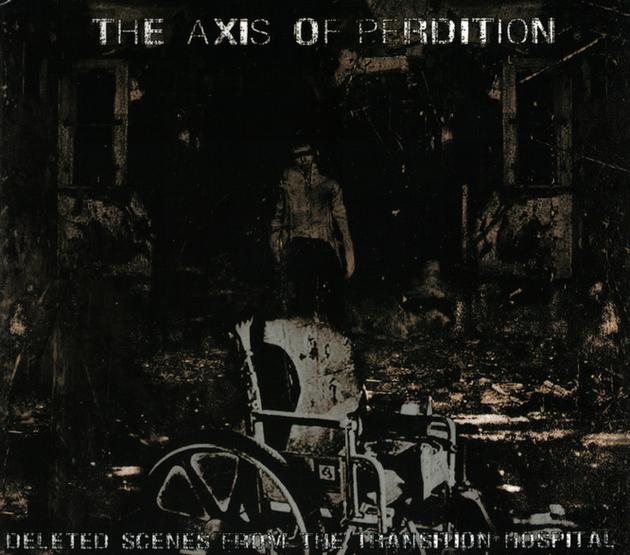
The Axis of Perdition - Deleted Scenes from the Transition Hospital
I serve none but Korrok!
Now, clearly I'm just rushing out a Halloween themed review, but the question I'm sure many metal fans may be asking is "If you're such a huge King Diamond fan, why not post something he was involved in like Fatal Portrait or Melissa? They both contain themes pertaining to Halloween". Well hypothetical reader, you're right, King has a fascination with this holiday that celebrates the dark and macabre like no other. But let's face it, though Halloween isn't really a "scary" day, in the days leading up to it, we all try to be scared. Horror movie marathons, haunted houses, getting blackout drunk and trying to take home Big Rhonda, we all do things that we hope will scare us. King is goofy as hell, I love him and you (should) love him too, but the dude embodies April Fool's Day more than Halloween. And that's why I've chosen to review the British industrial/black/ambient creatures in The Axis of Perdition, namely their second album: Deleted Scenes from the Transition Hospital.
I'm going to veer off track really quick and explain my thoughts on what horror truly is, what it is that genuinely scares people. Nobody is truly scared by slasher movies made post-1980, basically only Halloween and Friday the 13th have any real sense of dread, every other slasher movie since then has all been about the spectacle (unless you count the original Texas Chain Saw Massacre from 1974 as a slasher flick, then there are three acceptable scary ones). Haunted houses have a bit more emotional investment since you yourself are actually involved, but you know that you're just on rails and will be safe and sound in about a half hour, so there's no real suspense or danger about the people jumping out at you. When it comes to film, it's the ones that focus on what you don't see that are truly terrifying. The ones that build slowly and present a suffocating, claustrophobic atmosphere. John Carpenter's The Thing is my favorite movie ever, and I maintain that nothing else has ever had such a perfect balance of claustrophobic, paranoid terror, and the disgust and grotesquery when things go downhill. I can't explain what makes Takashi Miike's Audition so great without spoiling it for you, but trust me when I say you should watch it pronto. Ju-On (what would be remade in America as The Grudge) was probably the last movie to truly scare the fuck out of me, and it's not even a good movie. It builds up for 80-90 minutes with awful acting and bland characters and shit I just couldn't care less about, but the climax makes you realize how well everything came together, and concludes with such a harrowing final sequence that my breathing was noticeably accelerated when it ended.
And then we have videogames. Yeah I realize it seems silly, but believe me when I say a videogame, when well done enough, can be the scariest fucking thing imaginable. The good ones take the slow building, helpless, paranoid atmosphere of good horror films and adds the tension of haunted houses by placing you in control. Yeah, you can turn the game off, but when you're invested and playing, you may not escape, you may not make it out alive. One bad choice and you may find yourself face to face with your own mortality. Most games pegged with "horror" are silly, as I'm sure many people think of the Resident Evil series, which is about as scary as a white sheet with eyes drawn on it, but you catch the right thing and you're in for some grade-A nightmare fuel. Clocktower, Fatal Frame, Silent Hill, Amnesia, it's series like these that make you feel helpless and alone and terrified of a malevolent something that wants you dead. Anybody who has ever played these games knows what I'm talking about. Hell I haven't even been able to find the balls to play Fatal Frame without being surrounded by friends, that shit is soul-draining.
Why the long diversion? Well part of it is because tangential tirades are as much a part of my shtick as food similes and toilet humor, and the other part of it is because The Axis of Perdition gets their inspiration from the darkest and most twisted of the aforementioned ways to scare the piss out of you, the Silent Hill series. If you're one of those people who can easily be lost in the imagery that music can create, then I beg of you not to drop any acid or eat too much cheese before listening to Deleted Scenes from the Transition Hospital. The band's cultural background of being from England seeps through as well, as anybody who watches Cracked After Hours like I do was recently reminded that English horror seems to center around urban environments. That's what Deleted Scenes truly is, the horror and madness of a long dead and abandoned insane asylum, roving with malevolent apparitions whose sole purpose is to mindfuck you so hard that you give mindbirth. To nightmares.
There is a strong black metal influence at first, but it seems to diminish as the album goes on, eventually ending more into unsettling ambiance. "In the Hallway of Crawling Filth" is pretty much the perfect opener for this kind of experience. Ten minutes of uncomfortable atmosphere, punctuated occasionally by the soulless, dead sound of insanity. The drum machine works well here as opposed to being distracting like it normally would be. The cold, dead sound really brings to life the lifelessness of the afterlife, if that deliberately confusing sentence makes any sense to anybody other than myself. The old, long dead spirits have no empathy, and could not give less of a shit for your well being. They are cold, dead, soulless beings that want to make you an ex-person yourself, and the frantic sound of the drum machine encapsulates that lifeless frenzy so much more than any warm, tonal human player ever could. And even then, it is used very sparingly, only a handful of times on the album is there ever any real explosions of traditional music. Most of the time it's the quiet sound of hooks swaying in the breeze, big steel doors being slammed shut, large, rusty generators churning for the first time in eons. It is an industrial wasteland that houses horror yet unseen. And as the album goes on, the frantic drum bursts and distorted screams of torture and dissonant guitars become less and less prominent, with the last big chunk of the album being predominately ambient.
What this creates is that terror of the unknown I mentioned earlier. It makes you anticipate horror behind every turn, but the more turns you take without finding that macabre wretchedness that you're expecting, the more it builds, the more it permeates into your very consciousness and tests the limits of your sanity. This is what makes a jump scare work, it has to be earned and not just something popping up into frame accompanied by a loud orchestra sting. It's a fear that embeds itself inside your very core. And my favorite part is that in the last fifteen minutes or so of Deleted Scenes, there is precisely one loud part, and it's not even the end of the album. That's what makes this stick with you like the slow building horror of Japanese films, even when the album is done, you still feel that anticipation, that cautiousness that behind this next door could be some other unspeakable Lovecraftian monstrosity. The near constant white noise in the background of the entire 55 minute experience tests your sanity and loosens your grip on reality. It shows a disconnect between the real world and this nightmarish realm you've stepped inside, and it's small touches like that that make this album work so well. Moreso than anything else in this style, the background noises are really what make this so harrowing. The screams, the clicking, the creaking and moaning, the monologue in "One Day You will Understand Why", everything strikes just the right chords within you and puts you in this nightmare you've created for yourself.
Now with all of that said, this record is not perfect. I find the metal parts really do distract the listener from the atmosphere of the ambiance at times. The buildup is great and the release is wonderful, but I find it goes on for too long. It does the right thing, it's not particularly fast or musical, it's more droning, dissonant chords and anguished moaning punctuated with hellish roaring which does keep the mood where it needs to be, but the quiet, ambient parts are just so much more effective that I wish the album was 95% entirely that. "Entangled in Mannequin Limbs" jumps between the two styles too much to really let my mind take in the imagery, and it suffers for it.
But even with that quibble, I'd still highly recommend Deleted Scenes from the Transition Hospital, as it's probably one of the very few metal albums that actually conveys a sense of dread and terror, even if the metal parts themselves are the album's main downfall. In a perfect world, this would be almost entirely ambient, consisting only of horrid noises and the occasional anguished cry from the depths of the unknown. But as it stands, it still manages to depict a world of filth and decay populated by the restless dead who envy the living to the point of hatred. I love the atmosphere, and the Silent Hill influence is rather strong when the imagery is at its best, and that alone is reason enough to give the album a listen.
Happy Halloween, kids!
RATING - 84%
Now, clearly I'm just rushing out a Halloween themed review, but the question I'm sure many metal fans may be asking is "If you're such a huge King Diamond fan, why not post something he was involved in like Fatal Portrait or Melissa? They both contain themes pertaining to Halloween". Well hypothetical reader, you're right, King has a fascination with this holiday that celebrates the dark and macabre like no other. But let's face it, though Halloween isn't really a "scary" day, in the days leading up to it, we all try to be scared. Horror movie marathons, haunted houses, getting blackout drunk and trying to take home Big Rhonda, we all do things that we hope will scare us. King is goofy as hell, I love him and you (should) love him too, but the dude embodies April Fool's Day more than Halloween. And that's why I've chosen to review the British industrial/black/ambient creatures in The Axis of Perdition, namely their second album: Deleted Scenes from the Transition Hospital.
I'm going to veer off track really quick and explain my thoughts on what horror truly is, what it is that genuinely scares people. Nobody is truly scared by slasher movies made post-1980, basically only Halloween and Friday the 13th have any real sense of dread, every other slasher movie since then has all been about the spectacle (unless you count the original Texas Chain Saw Massacre from 1974 as a slasher flick, then there are three acceptable scary ones). Haunted houses have a bit more emotional investment since you yourself are actually involved, but you know that you're just on rails and will be safe and sound in about a half hour, so there's no real suspense or danger about the people jumping out at you. When it comes to film, it's the ones that focus on what you don't see that are truly terrifying. The ones that build slowly and present a suffocating, claustrophobic atmosphere. John Carpenter's The Thing is my favorite movie ever, and I maintain that nothing else has ever had such a perfect balance of claustrophobic, paranoid terror, and the disgust and grotesquery when things go downhill. I can't explain what makes Takashi Miike's Audition so great without spoiling it for you, but trust me when I say you should watch it pronto. Ju-On (what would be remade in America as The Grudge) was probably the last movie to truly scare the fuck out of me, and it's not even a good movie. It builds up for 80-90 minutes with awful acting and bland characters and shit I just couldn't care less about, but the climax makes you realize how well everything came together, and concludes with such a harrowing final sequence that my breathing was noticeably accelerated when it ended.
And then we have videogames. Yeah I realize it seems silly, but believe me when I say a videogame, when well done enough, can be the scariest fucking thing imaginable. The good ones take the slow building, helpless, paranoid atmosphere of good horror films and adds the tension of haunted houses by placing you in control. Yeah, you can turn the game off, but when you're invested and playing, you may not escape, you may not make it out alive. One bad choice and you may find yourself face to face with your own mortality. Most games pegged with "horror" are silly, as I'm sure many people think of the Resident Evil series, which is about as scary as a white sheet with eyes drawn on it, but you catch the right thing and you're in for some grade-A nightmare fuel. Clocktower, Fatal Frame, Silent Hill, Amnesia, it's series like these that make you feel helpless and alone and terrified of a malevolent something that wants you dead. Anybody who has ever played these games knows what I'm talking about. Hell I haven't even been able to find the balls to play Fatal Frame without being surrounded by friends, that shit is soul-draining.
Why the long diversion? Well part of it is because tangential tirades are as much a part of my shtick as food similes and toilet humor, and the other part of it is because The Axis of Perdition gets their inspiration from the darkest and most twisted of the aforementioned ways to scare the piss out of you, the Silent Hill series. If you're one of those people who can easily be lost in the imagery that music can create, then I beg of you not to drop any acid or eat too much cheese before listening to Deleted Scenes from the Transition Hospital. The band's cultural background of being from England seeps through as well, as anybody who watches Cracked After Hours like I do was recently reminded that English horror seems to center around urban environments. That's what Deleted Scenes truly is, the horror and madness of a long dead and abandoned insane asylum, roving with malevolent apparitions whose sole purpose is to mindfuck you so hard that you give mindbirth. To nightmares.
There is a strong black metal influence at first, but it seems to diminish as the album goes on, eventually ending more into unsettling ambiance. "In the Hallway of Crawling Filth" is pretty much the perfect opener for this kind of experience. Ten minutes of uncomfortable atmosphere, punctuated occasionally by the soulless, dead sound of insanity. The drum machine works well here as opposed to being distracting like it normally would be. The cold, dead sound really brings to life the lifelessness of the afterlife, if that deliberately confusing sentence makes any sense to anybody other than myself. The old, long dead spirits have no empathy, and could not give less of a shit for your well being. They are cold, dead, soulless beings that want to make you an ex-person yourself, and the frantic sound of the drum machine encapsulates that lifeless frenzy so much more than any warm, tonal human player ever could. And even then, it is used very sparingly, only a handful of times on the album is there ever any real explosions of traditional music. Most of the time it's the quiet sound of hooks swaying in the breeze, big steel doors being slammed shut, large, rusty generators churning for the first time in eons. It is an industrial wasteland that houses horror yet unseen. And as the album goes on, the frantic drum bursts and distorted screams of torture and dissonant guitars become less and less prominent, with the last big chunk of the album being predominately ambient.
What this creates is that terror of the unknown I mentioned earlier. It makes you anticipate horror behind every turn, but the more turns you take without finding that macabre wretchedness that you're expecting, the more it builds, the more it permeates into your very consciousness and tests the limits of your sanity. This is what makes a jump scare work, it has to be earned and not just something popping up into frame accompanied by a loud orchestra sting. It's a fear that embeds itself inside your very core. And my favorite part is that in the last fifteen minutes or so of Deleted Scenes, there is precisely one loud part, and it's not even the end of the album. That's what makes this stick with you like the slow building horror of Japanese films, even when the album is done, you still feel that anticipation, that cautiousness that behind this next door could be some other unspeakable Lovecraftian monstrosity. The near constant white noise in the background of the entire 55 minute experience tests your sanity and loosens your grip on reality. It shows a disconnect between the real world and this nightmarish realm you've stepped inside, and it's small touches like that that make this album work so well. Moreso than anything else in this style, the background noises are really what make this so harrowing. The screams, the clicking, the creaking and moaning, the monologue in "One Day You will Understand Why", everything strikes just the right chords within you and puts you in this nightmare you've created for yourself.
Now with all of that said, this record is not perfect. I find the metal parts really do distract the listener from the atmosphere of the ambiance at times. The buildup is great and the release is wonderful, but I find it goes on for too long. It does the right thing, it's not particularly fast or musical, it's more droning, dissonant chords and anguished moaning punctuated with hellish roaring which does keep the mood where it needs to be, but the quiet, ambient parts are just so much more effective that I wish the album was 95% entirely that. "Entangled in Mannequin Limbs" jumps between the two styles too much to really let my mind take in the imagery, and it suffers for it.
But even with that quibble, I'd still highly recommend Deleted Scenes from the Transition Hospital, as it's probably one of the very few metal albums that actually conveys a sense of dread and terror, even if the metal parts themselves are the album's main downfall. In a perfect world, this would be almost entirely ambient, consisting only of horrid noises and the occasional anguished cry from the depths of the unknown. But as it stands, it still manages to depict a world of filth and decay populated by the restless dead who envy the living to the point of hatred. I love the atmosphere, and the Silent Hill influence is rather strong when the imagery is at its best, and that alone is reason enough to give the album a listen.
Happy Halloween, kids!
RATING - 84%
Friday, June 17, 2011
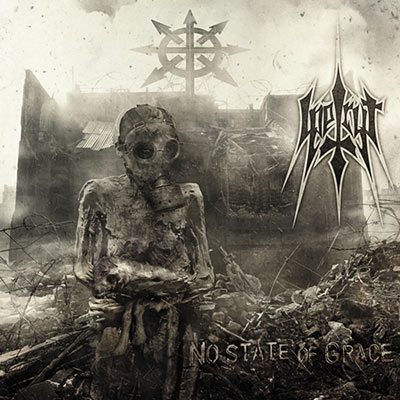
BITE SIZED: Iperyt - No State of Grace
I have absolutely no idea how industrial black metal works or is supposed to sound, all I know is that whatever Iperyt put out last February is something to be reckoned with. No State of Grace is just totally suffocating in its atmosphere and overwhelming in its brutality. The production heavily favors the enraged vocals and computerized percussion, with the bass and guitars pushed to the background. It works really well for what the album is trying to do, which is to just completely isolate the listener in a desolate wasteland of misanthropy and despair. Everything about this is angry and vengeful, and the industrial overtones help hammer it home like none other. The traditional misanthropy that just comes with the black metal territory works hand in hand with the dead mechanization and isolation of the industrial elements and they blend together so well that it's hard to call this more of one style. I dunno, it's hard for me to really formulate the words behind why I like No State of Grace so much, which is why this is a short BS review instead of a full one like I was planning. Just know it's great.
Subscribe to:
Comments (Atom)